


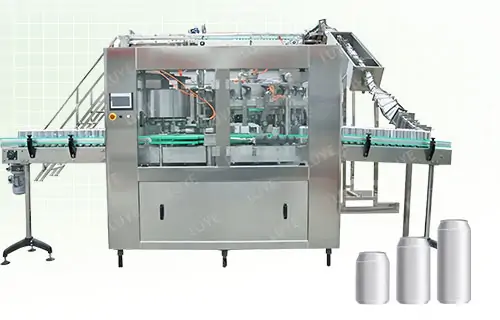




How Does Glass Bottle Filling Equipment Support Production
Glass bottle filling equipment plays an important role in beverage production where bottle washing, filling, and sealing need to work in sequence. Luye Packaging provides equipment for glass bottle carbonated beverages such as soft drinks, beer, and carbonated fruit drinks. Combining several processes in one machine helps reduce bottle transfer and supports continuous production.

Stable Bottle Feeding Keeps the Line Moving:
Continuous production starts with steady bottle feeding. Empty glass bottles need to enter the washing section at a consistent rate. If bottle feeding becomes uneven, the following filling and capping processes may also slow down.
The equipment connects bottle washing, filling, and capping into one operating sequence. This reduces unnecessary bottle handling between individual machines. As a result, the production process can maintain a more consistent flow.
For beverage plants looking for an integrated solution, a glass bottle filling machine can combine several key operations in one unit.
Glass Bottle Filling Equipment Combines Three Main Processes:
Glass bottle carbonated beverage filling equipment combines bottle washing, liquid filling, and crown cap sealing in one machine. This arrangement reduces bottle transfer and helps keep the main production stages running in sequence.
The equipment consists of three main sections: a bottle washing unit, a filling unit, and a capping unit. A drive motor uses gear transmission to rotate these sections. The suitable gear ratio helps maintain stable machine operation and production output.
The filling section uses a high-precision mechanical filling valve. The equipment also uses PLC control and variable-frequency stepless speed regulation. Operators can adjust the machine speed according to production requirements.
The production sequence usually covers bottle rinsing, liquid filling, cap placement, sealing, and bottle discharge. When these stages work together, the line can continue production with less manual intervention.

Filling Conditions Need to Match Glass Bottle Production:
The equipment is designed for glass bottles with a height of 170–320 mm and a diameter of 50–100 mm. The bottle washing pressure is 0.25–0.3 MPa.
Different models provide different production capacities. The listed capacity ranges from 2,000 bottles per hour for BGF14-12-4 to 30,000 bottles per hour for BGF80-80-22. Therefore, the machine model should match the required output and bottle specifications.
The equipment also uses two vacuum functions and a high-pressure bubbling device. These functions work with the mechanical filling valve during carbonated beverage filling.
Machine Configuration Affects Production Capacity:
The number of washing heads, filling heads, and capping heads changes with the machine model. For example, the BGF14-12-4 model has 14 washing heads, 12 filling heads, and 4 capping heads. The BGF80-80-22 model has 80 washing heads, 80 filling heads, and 22 capping heads.
This configuration allows different machine models to match different production capacities. The equipment also uses an open gear and gearbox combination with variable-frequency stepless speed regulation. This design provides a wide speed adjustment range for production operation.
The complete production setup should also consider bottle size, beverage type, required output, and connected equipment. When these conditions match, the washing, filling, and sealing stages can work together more smoothly.
Routine Maintenance Helps Maintain Stable Operation:
Continuous production still requires routine inspection and maintenance. Operators need to pay attention to the bottle washing section, filling valves, capping mechanism, transmission system, sensors, and control components.
PLC control and a touch-screen operating system make daily operation more convenient. Operators can monitor machine operation and adjust the running speed through the control system.
Regular maintenance can also help identify worn components or abnormal operation before they cause unexpected shutdowns. The actual maintenance schedule should depend on production hours, beverage type, bottle specifications, and the working environment.
For a complete beverage production project, a glass bottle carbonated beverage production line can be selected when coordinated washing, filling, sealing, and downstream processes are required.
FAQ:
Q1: How does glass bottle filling equipment support production?
A: It combines bottle washing, filling, and crown cap sealing in one machine, allowing the main processes to run in sequence.
Q2: What glass bottle sizes can the equipment handle?
A: The equipment is designed for glass bottles with a height of 170–320 mm and a diameter of 50–100 mm.
Q3: What production capacity can the equipment provide?
A: The listed models range from 2,000 to 30,000 bottles per hour. The suitable model depends on the required output.
Q4: Can the equipment fill carbonated beverages?
A: Yes. It is designed for glass bottle carbonated beverages such as soft drinks, beer, and carbonated fruit drinks.


